

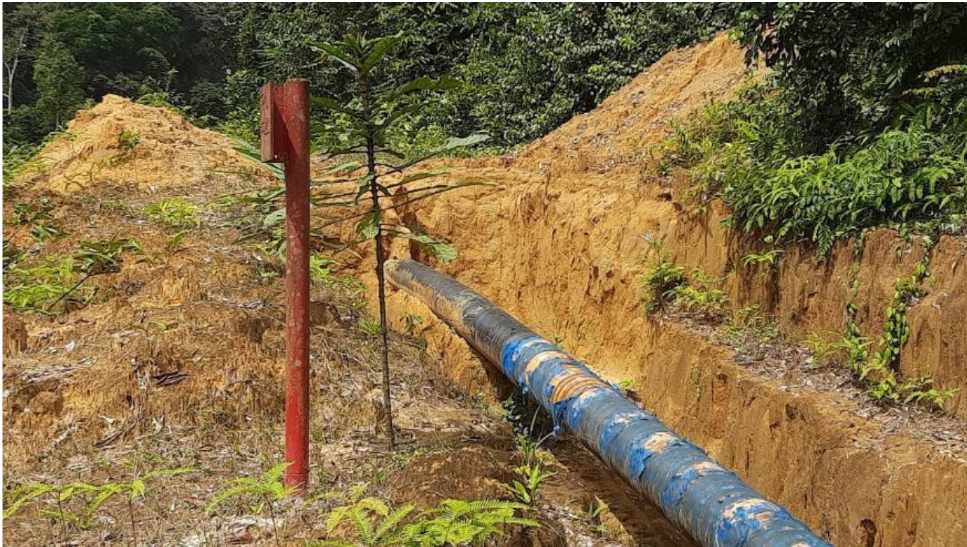
Case Study: An 18” crude oil pipeline with a total distance covered – 3450 m.
The time of scanning was 2 h. 10 m, including pauses for a road cutting. The main challenge was that the customer refused to do any excavation as it was a rainy season. The solution was to use the data of previous ILI inspections as a reference. The customer provided ILI data for 3 points selected according to NCM data analysis.
Also, an exposed part of the same pipeline was inspected, with the aim of using it as a reference instead of a verification excavation.
Findings and results: A large number (60) of anomalies corresponding to a stressed-deformed state combined with local damage were detected within the inspected section of the pipeline. 14 of them listed in the Final report, have magnetic characteristics similar to those obtained at the exposed section, and, therefore, are assessed as having a similar nature of damage. NCM experts
Regular monitoring in the area of the above anomalies is recommended.
Though no Priority-1 (emergency state) anomalies were detected within the inspected section, the significant number of magnetic anomalies and their density doesn’t allow the NCM experts to evaluate the current state of the inspected section of the pipeline as good.